
Opening: May 7, 2026, 18.00
The exhibition runs through 7 to 30 May, 2026, and is open to the public Tuesday through Saturday from 11.00 to 18.00.
Participants: Jakub Woynarowski and representatives of the Institute of Architecture
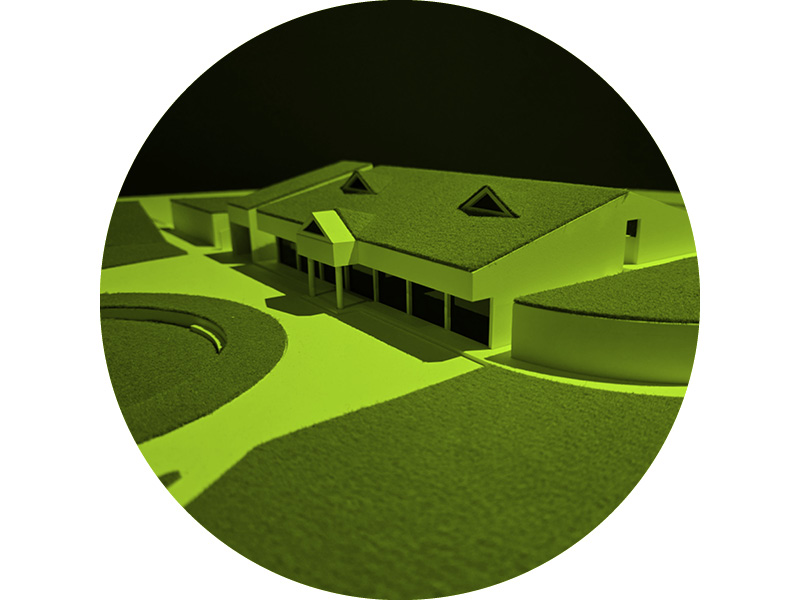
We invite you to the ICC Bookstore for the presentation of Jakub Woynarowski’s model. The work is an attempt to depict the stylistic impossibility that is the idea of “sarmatian modernism”. It combines a traditional manor house with modern architecture and luxury. It unites opposites in a single design: open and closed forms, the garden house and the fortress house, modernity and tradition. What does it say about today’s social issues related to housing?
Housing as a Right, Housing as a Commodity
The “Sarmatian Modernism” project was presented in 2016 as part of the 8th edition of the Warsaw Under Construction festival, at the exhibition “Home at Last: The Polish House During the Transition”. One of its curators was Dr. Michał Wiśniewski, head of the Educational Department – Heritage Academy at the ICC (other members of the curatorial team: Tomasz Fudala, Dorota Jędruch, Marta Karpińska, Dorota Leśniak-Rychlak, Szymon Maliborski). Jakub Woynarowski’s work, which will be on display at the ICC Bookstore on the first floor, is already 10 years old, yet it demonstrates that when it comes to housing, we still face similar challenges and require well-thought-out solutions. The theme of the exhibition for which it was created was the transformation of the home and the residential environment in Poland during the transition period, as well as the functioning of the new globalized housing model. Today, a heated debate has resurfaced regarding the need for active state policy, social housing, and rental market regulation. The call to treat housing not as a commodity but as a fundamental civil right is growing ever louder.
The Nostalgic “Manor” and Modernity
The central element of Jakub Woynarowski’s work is an architectural model that attempts to answer the question of whether the idea of “sarmatian modernism” can be realized. It combines two dominant, yet seemingly mutually exclusive models of habitation analyzed in the 2016 exhibition: the traditional, nostalgic “manor” (symbolizing Sarmatian roots and aspirations) and neo-modernist minimalism (representing modernity and global capital). The project was directly inspired by the pre-war Józef Piłsudski Memorial Reserve in Zułów (designed by Romuald Gutt), where, instead of rebuilding the manor, its foundations were left exposed. Woynarowski superimposed contemporary luxury development standards onto this architectural layout.
The design presents an “underground manor,” combining paradoxical opposites: modernity and luxury. The traditional layout of the building has been integrated with a garage and an infinity pool. The estate is surrounded by “fortifications” in the form of a moat and a wall, intended to deter intruders, which alludes to the issue of fear and an obsession with security in contemporary residential developments. The design combines the form of a garden house with that of a closed fortress.
“A Home of One’s Own” – Security and Divisions
The work “sarmatian modernism” is a visual metaphor for the “domestication” of political change. At the 2016 exhibition, it showed how the Polish middle class, unable to clearly define its position, “wallows in nostalgic fantasies of a pseudo-aristocratic past”, yet simultaneously strives for hyperglobal, modern models of consumption. Today we return to it because the problems diagnosed at that time have not only not disappeared but have deepened. In hindsight, it is clear that the Polish housing market is in a phase of intensification of phenomena that were previously only the subject of preliminary criticism. Housing prices have risen significantly faster than public incomes, making it even harder for young people to secure their own homes than it was a decade ago. Housing functions even more clearly than a decade ago as part of the global financial market and phenomena such as the growth of institutional leasing and the treatment of real estate as a pure capital investment have intensified.
Uncertainty and anxiety are also fueled by volatile economic conditions, including mortgages, which remain the primary means of entering the market. In the face of the escalating climate crisis, the model of the individual suburban home—reliant on fossil-fueled transportation and high energy consumption—is viewed as unsustainable and too costly for society. “A home of one’s own,” which for many remains a symbol of security, has at the same time become a sign of growing social divisions and tensions, as well as the exclusion of those who cannot afford one.
***
The exhibition “Home at Last: The Polish House During the Transition” which featured the model, was held in the space of a former printing house on Nowogrodzka Street in Warsaw, in collaboration with: the Museum of Modern Art in Warsaw, the Museum of Warsaw, and the Institute of Architecture (Dorota Jędruch, Marta Karpińska, Dorota Leśniak-Rychlak, Agata Wiśniewska, Michał Wiśniewski).