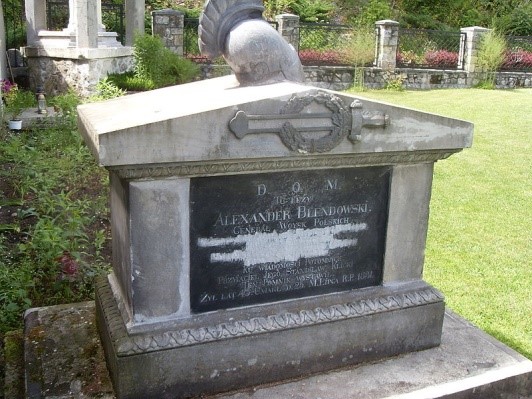
Cholera was equally generous among Poles. One of its victims was wounded and taken prisoner near Wawer, Brigadier General Aleksander Błędowski. Released after, he died in November 1831 in hospitality at the Potocki family in Krzeszowice near Kraków. He was buried in the monastery cemetery of the Discalced Carmelites in Czerna. The tomb of the general that has survived to this day catches the eye partly due to the inscription. This vandalism, which is one of the first manifestations of foreign censorship, was committed in 1836 by the Austrian authorities, which had been occupying the autonomous Republic of Krakow from this year. At the request of Russians, the middle lines from the monument were removed: “whose bullets were passing by the damn / the fierce companion of Muscovites/caused death”.
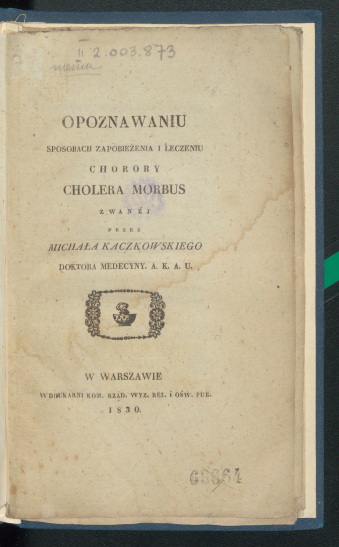
However, before the Russians entered Polish lands, they struggled with an epidemic in their own territory. It exploded in Moscow at the end of the summer of 1830. However, it was particularly wild in the capital of the empire – St. Petersburg. In 1831 brochure on how to treat cholera in places without pharmacies or doctors was printed. It recommended isolating patients in warm and dry homes (which was not easy in the Neva Delta, a windy and canal-filled city), bleeding or applying leeches, watering with herbal infusions, tinctures on spirit and rubbing the body with spirit. Meanwhile, a year earlier, a scientific work appeared in Warsaw “On cognition, ways to prevent and treat cholera morbus disease” called by dr. Michał Kaczkowski, whose brother Karol became a staffer of the Polish army in 1831. However, both publications did not have a major impact on the course of the epidemic.
Publications
Publications
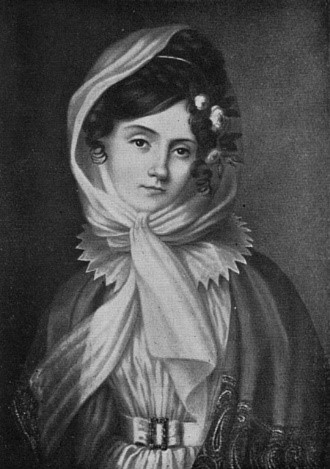
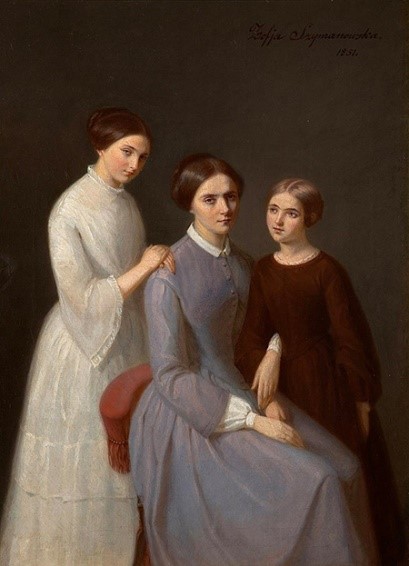
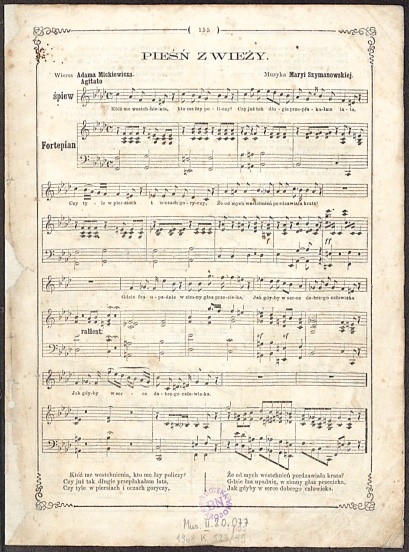
One of St. Petersburg’s cholera victims was Polish pianist and composer Maria Szymanowska, who died there on July 25, 1831. She appeared on the Neva for the first time in March 1822. Performances in the capital of the empire earned her the honorary title of the “First Piano Player of Their Majesty the Empress” – Jelizaviet Alieksiejewny, wives of Aleksander I and Maria Fiodorowny, widow of Paweł I.
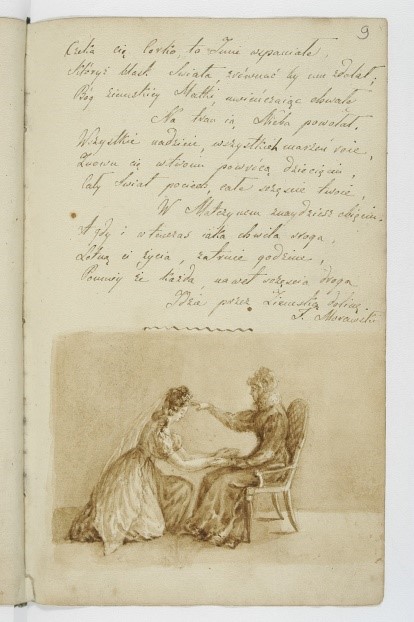
She left to Russia in November 1827, taking her daughters – Helena and Celina. She spent the first months in Moscow, where she renewed her contacts with Fr. Piotr A. Wiaziemski, who introduced her to Adam Mickiewicz. In March 1828 she lived in St. Petersburg. She devoted herself to teaching and composing here, and her salon quickly became a meeting place for the artistic and intellectual elite of the city. Poles and Russians, as well as foreigners visiting the Russian capital hosted here. Among them were the following writers: A. Mickiewicz, who in 1834 married her daughter Celina in Paris, Aleksander S. Pushkin, Ivan I. Kozlov, Ivan A. Krylov and Wasilij A. Żukowskij; musicians: Alexei F. Lvov, John Field, Józef Kozłowski – author of music to the words of the poet Gawriił R. Dierżawin “Let the sound of victory resound”, a song considered until 1816 as the unofficial anthem of the Russian Empire, Mikhail I. Glinek, brothers Maciej and Michał Wielhorscy; painters Józef Oleszkiewicz, Aleksander Orłowski, Walenty Wańkowicz and, among others orientalist Aleksander Chodźko and lawyer Franciszek Malewski – from 1832 husband of the second daughter of Szymanowska, Helena. Numerous traces of these acquaintances have been preserved in the famous pianist’s albums kept in the Polish Library in Paris.
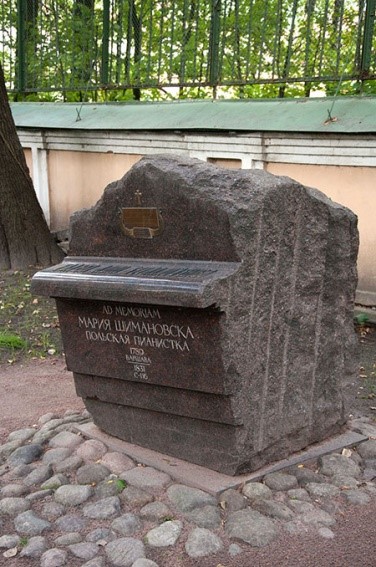
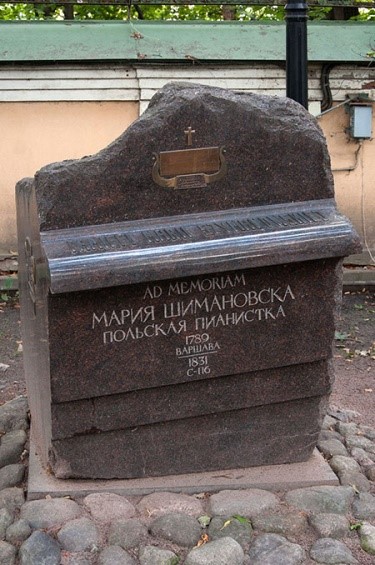
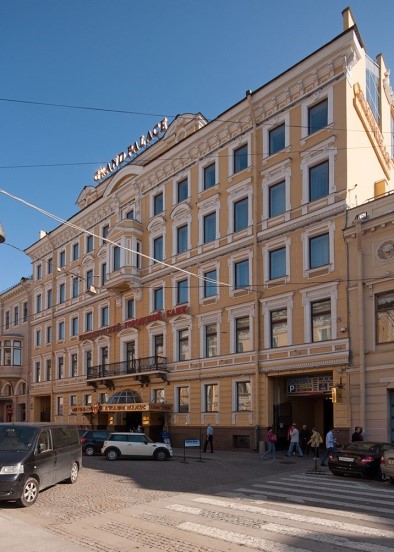
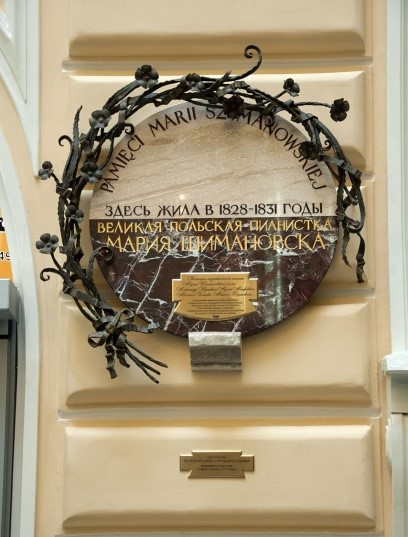
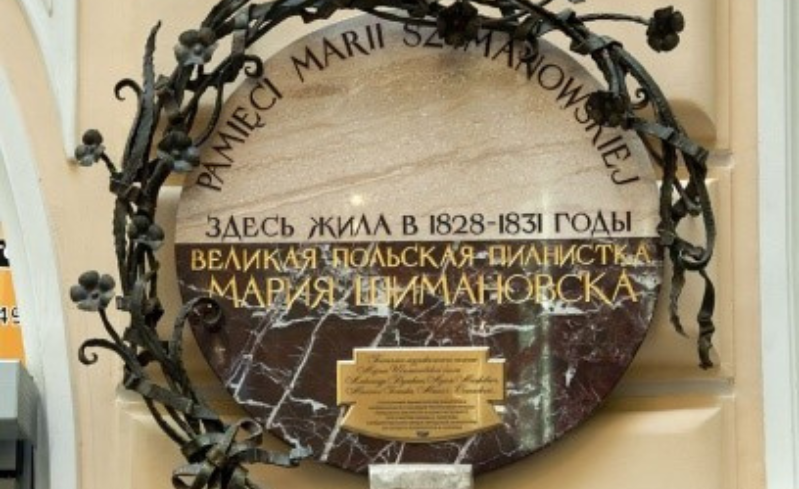
She was buried in the Mitrofaniewski cemetery, liquidated after 1927. On September 25, 2010, at the Necropolis of Masters of Art (next to the Nevsky Lavra), the cenotaph of Szymanowska was unveiled, and on June 27, 2013, a commemorative plaque on the facade of the tenement house at ul. Italianska 15 (near Prospect. Nevsky), which she occupied with piano nobile. The author of both commemorations is the famous St. Petersburg sculptor and architect Vyacheslav Buchayev.
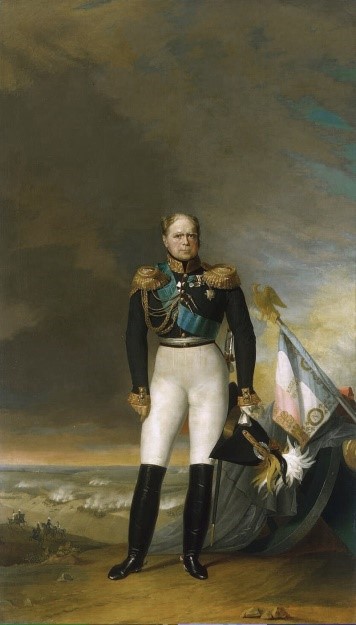
You can read more about Maria Szymanowska, regulars in her salon and the great prince Konstanty Pawłowicz and his Polish wife Joanna Grudzińska in the Polish Petersburg online encyclopedia (article in Polish).