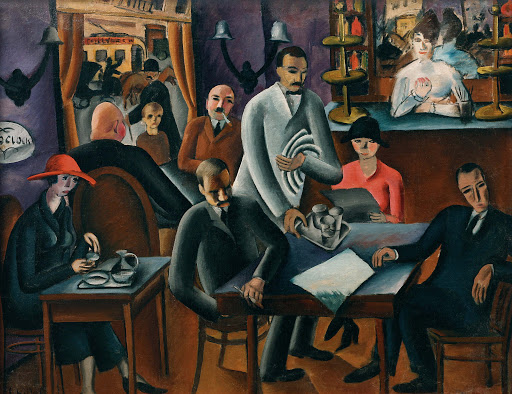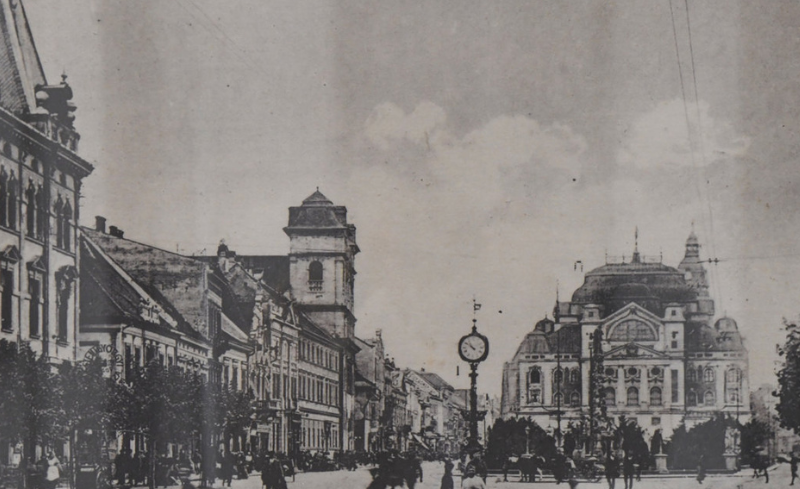
The city was not only a natural frame for the daily existence of artists, but also became a source of inspiration. In their works, Košice real meets the imaginary. Therefore, fragments of the urban landscape, symbols of industrialization and civilization progress, urban lifestyle and leisure culture, such as the theme of a cafe, were readily used. He appears with Géza Schiller, who, before arriving in Košice, was associated, among others, with the Budapest community. The artist, a frequent visitor of cafes, in which he passionately devoted himself to discussions on Picasso’s work – which, incidentally, earned the nickname Silanyi-Schiller Picasso – recreated the atmosphere of the well-known venues in his work entitled “In the cafe” (1924). The crowded interior is filled with various types of characters – a figure of a waiter appears in the foreground serving a group of guests, a female figure pensive over the cup, a bored girl leaning her elbows on a cafe counter. It resembles a bartender from the iconic image of Édouard Manet “Bar in Folies-Bergère”. Similarly, the male figure in the right part of the canvas can be a distant echo of the works of Picasso or Modigliani.
Publications
Publications
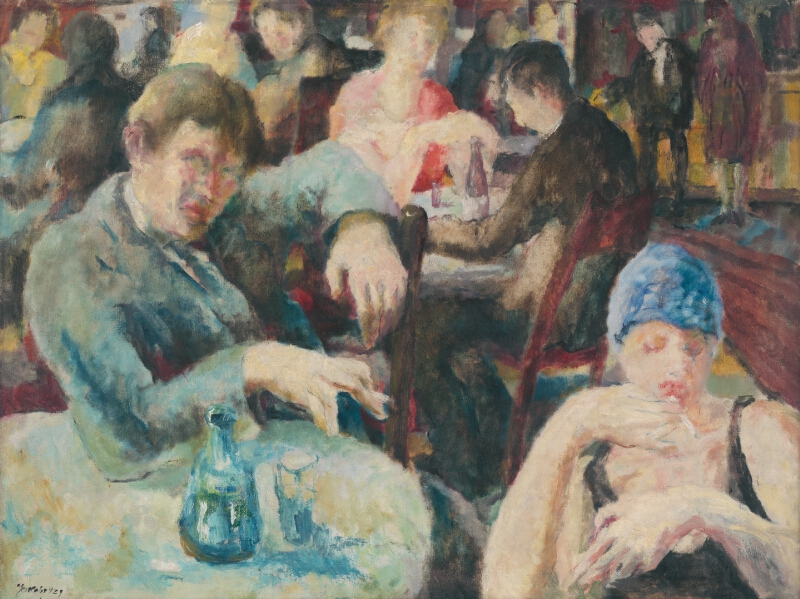
The same motif, but obtained quite differently by means of painting, can be found in Július Jakoby from Košice, sometimes called the city’s “chronicler”. In the composition “In the bar” (1929), attention is drawn to a somewhat fragmentary, “snapshot” framing – it is manifested even in the “cut off” silhouette of the female figure and closeness to the foreground. The couple depicted freely on chairs and with cigarettes in their hands, silently devote themselves to the cafe ritual. This small detail also reminds that the interwar period contributed to the popularization – now quite not so enthusiastically supported – of the habit of smoking cigarettes, which in the case of women was even emancipatory and at the same time an inseparable attribute of cafe life.
Publications
Publications
We exhibited avant-garde paintings by artists from Košice, created in the second decade of the 20th century, at the MCK from 16 September to 27 November 2016 – link to the article on the exhibition ‘Košice Modernism’.