
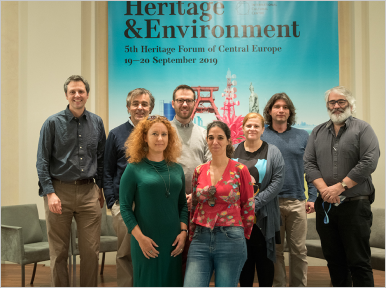
Between 2018 and 2021, we participated in the international project “Heritage Opportunities/Threats Within Mega-Events in Europe” (HOMEE), carried out in partnership with the Politecnico di Milano and the universities of Pafos and Hull. Its aim was to gain a better understanding of the relationship between mega-events and cultural heritage policies, as well as to examine the impact of large-scale events on cities rich in heritage assets.
Charter for Mega-Events in Heritage Cities
As a result of the project, a Charter for Mega-Events in Heritage Cities was developed, comprising a set of good practices and guidelines for organisers of events in historic urban spaces.
HOMEE
Charter for Mega-Events in Heritage Cities…PDF (1 KB)

In the past, many cities used large-scale events to support investment projects, develop tourism, and enhance their competitiveness. Until recently, organisers of major international events placed primary emphasis on the construction of new sports or cultural infrastructure. Today, however, there is a growing focus on making use of existing facilities, revitalising them, or adapting them to new purposes.
Mega-events create both opportunities and risks for cultural heritage. On the one hand, such events can contribute to the development of local economies; on the other, they may intensify processes of gentrification and touristification in historic city centres. The participants of the HOMEE project set out to examine these complex relationships and to propose practical solutions that could help organisers minimise the risk of negative impacts of mega-events on the historic urban landscape.
The HOMEE project brought together leading research centres specialising in the protection of cultural heritage. Associated partners included institutions and municipal authorities directly responsible for the planning and implementation of mega-events at both the local and international levels.
The project’s research objectives were pursued through extensive literature reviews and case study analyses of Genoa (European Capital of Culture 2004), Milan (EXPO 2015), Wrocław (European Capital of Culture 2016), Hull (UK City of Culture 2017), Pafos (European Capital of Culture 2017), and Matera-Basilicata (European Capital of Culture 2019).
Project Conclusion
The project culminated in a seminar during which the “Charter for Mega-Events in Heritage Cities” was presented. The document sets out principles and guidelines designed to enable cities to take advantage of the opportunities generated by large-scale events, while also minimising the risks associated with their organisation.
The “HOMEE Charter” addresses a wide range of aspects related to mega-events, from new ways of using historic spaces, through preventing the overburdening of heritage sites, to shifts in how heritage places are understood and perceived. It also identifies key challenges for organisers, including local authorities.
Research Questions
- What gaps exist in the current understanding of the relationship between cultural heritage and policies governing the implementation of mega-events?
- How do heritage protection and conservation policies address the risks and opportunities generated by mega-events in heritage-rich European cities?
- Do the key stakeholders involved in decision-making regarding mega-events and heritage policies possess the necessary knowledge and appropriate planning tools?
- How can these tools be improved, and who should be involved in the decision-making process?
Project Objectives
- A better understanding of the relationship between mega-events and cultural heritage policies through the analysis of implemented projects in heritage cities.
- Raising awareness among decision-makers involved in cultural heritage and mega-events at the local, national and supranational levels, so that they clearly identify the risks and opportunities arising from the planning and implementation of mega-events and address these issues more effectively in the context of historic cities.
- Engaging local stakeholders and ensuring their participation in the decision-making process in order to align local interests with global cultural values.
- Developing, in collaboration with decision-makers responsible for mega-event policies at various scales and levels, innovative guidelines and planning tools that promote a more sensitive approach to heritage in the implementation of mega-event initiatives and projects (the HOMEE Charter).
Coordinating institution:
Politecnico di Milano – Department of Architecture and Urban Studies (Italy)

Project partners:
University of Hull – Culture, Place and Policy Institute (United Kingdom); Neapolis University Pafos – Department of Architecture, Land and Environmental Science (Cyprus); International Cultural Centre in Kraków (Poland)
Associated partners:
University Network of the European Capitals of Culture (UNeECC); European Network on Cultural Management and Policy (ENCATC); Ministry of Cultural Heritage and Activities (MiBAC); Heritage Lottery Fund (HLF); National Heritage Board of Poland; Kaunas 2022 European Capital of Culture; Matera-Basilicata 2019 Foundation; University of Basilicata; Pafos District; Pafos 2017 Organization; City of Milan; Wrocław Culture Zone; City of Kraków; Krakow Festival Office; Robert Palmer Consultants; National Research University Higher School of Economics; Cracow University of Economics
The project was co-financed by the Ministry of Culture and National Heritage under the programme JPICH Heritage in Changing Environments – support for research on cultural heritage within the Joint Programming Initiative on Cultural Heritage (JPICH).
