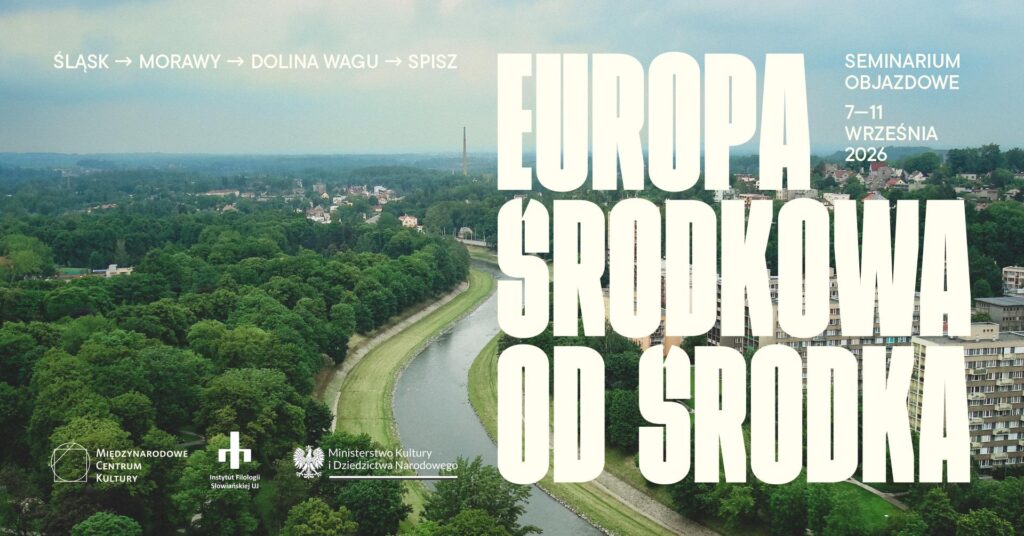
Central Europe from the Inside is more than just a study tour. It is an intensive journey through our corner of Europe, to which we invite those who wish to better understand the region in which they live – its history, culture, conflicts, memory and present-day reality.
Together with researchers and experts from the International Cultural Centre and the Institute of Slavic Philology at the Jagiellonian University, participants will embark on a five-day tour through Silesia, the Czech Republic, Slovakia, the Tatra Mountains and Spiš, visiting places that offer a view of Central Europe from within.
We particularly invite students, PhD candidates, those interested in the history, culture and travel of Central Europe, and staff employed in Polish cultural institutions seeking to expand their networks of cooperation. The programme is aimed at anyone wishing to move beyond stereotypical thinking about the region and see how closely languages, traditions, religions and historical experiences intertwine here.
During the seminar, participants will visit, amongst other places, Pszczyna, Cieszyn, Ostrava, Žilina, Levoča, Stará Ľubovňa and Niedzica. The programme will include meetings, workshops and visits to places significant to the region’s history: castles, border towns, places of worship of various faiths, and sites associated with industrial modernity and social change in Central Europe.
The seminar combines a humanities perspective with the experience of travel. It is an opportunity to discuss the region’s identity, its multiculturalism and contemporary challenges – but also to get to know people and places that are difficult to understand solely through books or lecture halls.
The programme is organised by the International Cultural Centre and the Institute of Slavic Philology at the Jagiellonian University. Places are limited – 25 participants can take part.
Practical information:
- Dates: 7–11 September 2026.
- Registration: until 31 July 2026.
- Languages of instruction: Polish, English
- Number of places: 25. Places are allocated on a first-come, first-served basis.
- Price:
– for participants staying in Kraków – price until 30 June: 1,300 PLN; until 10 July: 1,600 PLN
– for participants from outside Kraków – until 30 June: 1,500 PLN; until 10 July: 1,800 PLN. - An initial deposit of PLN 300 is required, which will be deducted from the total amount.
- Account number: Bank BGK 18 1130 1150 0012 1269 6920 0001.
- For further information, please contact Marek Świdrak: m.swidrak@mck.krakow.pl.
Application form
No places available. Applications are now closed.
Course leaders:
Dr Dorota Bielec – a Czech studies scholar, Doctor of Humanities, Assistant Professor at the Department of Czech and Lusatian Philology, Institute of Slavic Philology, Jagiellonian University, and Deputy Director of the Institute of Slavic Philology at the Jagiellonian University. Her research interests include 20th- and 21st-century Czech literature and culture, identity processes in Central Europe, the relationship between culture and politics, autobiographical writing in literature, and issues of translation. She also works on linguistic issues, collaborating on projects devoted to Polish-Czech lexicography and phraseology.
Prof. Maciej Czerwiński, PhD – a philologist specialising in Croatian studies, a professor at the Jagiellonian University, director of the Institute of Slavic Philology at the Jagiellonian University, and director of the Doctoral School of Humanities at the Jagiellonian University. His research focuses on the languages, cultures and literatures of the former Yugoslavia, as well as the intersection of language and literary theory, including issues of historical discourse. He has lectured and delivered presentations at symposia in many European countries and the United States. He is the author of several books published in Poland and Croatia, as well as numerous articles and essays. At the ICC, he co-curated the exhibition “Adriatic epopee. Ivan Meštrović” (2017) and has published essays in the journal “Herito”. He is also the author of the book “Croatia. History, Culture, Ideas”, published by the International Cultural Centre.
Dr Rafał Majerek – a specialist in Slavic and Slovak studies, Doctor of Humanities in the field of literary studies, and Assistant Professor at the Institute of Slavic Philology, Jagiellonian University. He is the author of works on Slovak national and cultural identity and contemporary Slovak literature. His research interests include, among other things, processes of self-identification, reinterpretations of history, representations of minorities, and the links between contemporary discourses of emancipation and literature. He is also involved in promoting Slovak literature and culture in Poland.
Marek Świdrak – art historian and lawyer. Professionally affiliated with the International Cultural Centre and the Institute of Art History at the Jagiellonian University. His academic specialisms include the history of modern art, heritage protection law and cultural heritage management. He is a fellow of the Lanckoroński Foundation.
Dr Michał Wiśniewski – representative of the Education Department – Heritage Academy at the International Cultural Centre, architectural historian, curator of architectural exhibitions, author of books on the history of architecture in Poland and worldwide in the 19th and 20th centuries, including monographs on Kraków architects Ludwik Wojtyczka, Adolf Szyszko-Bohusz and Witold Cęckiewicz. Staff member at the University of Economics in Kraków and a Fulbright scholar. Co-founder and board member of the Architecture Institute Foundation. Co-creator of the Kraków Modernism Trail online project.
PROGRAMME:
Day 1 (departure from Kraków, hotel in Cieszyn):
8.00: Meet and depart from Kraków
8.00 – 9.30: Journey to Tychy
9.30 – 10.45: Visit to Tychy
Post-war modernity and industrialisation, cultural and social changes in Silesia, outstanding examples of Social Modernist architecture.
10.45 – 11.30: Journey to Pszczyna
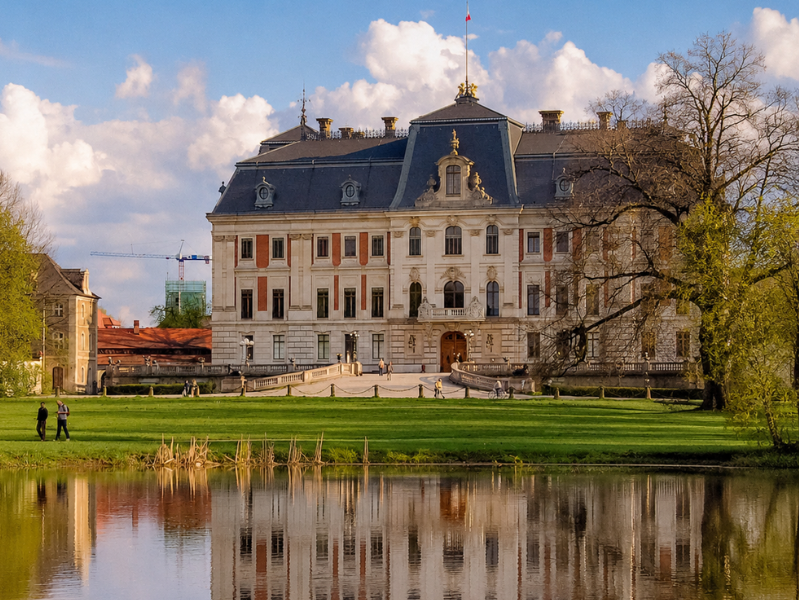
11.30 – 13.00: Visit to Pszczyna Castle
A reminder of the Industrial Revolution and the great fortunes of the Prussian aristocracy in the 19th century. The decision-making centre of the First World War.
13.00 – 14.30: Lunch in Pszczyna
14.00 – 15.00: Transfer to Wisła
15.00 – 16.30: Visit to Wisła Castle or Wisła
The residence of the Polish head of state during the interwar period, built on the border with Czechoslovakia and Germany.
16.30 – 17.30: Transfer to Cieszyn
17.30 – 19.30: Tour of Cieszyn (Church of Grace, Market Square, Tower, Bridge, Czech Market Square, Czech Railway Station):
The religious wars of the 17th and 18th centuries, the history of Protestantism in Polish lands, the history of a divided border town, rivalry and the struggle for Cieszyn Silesia in the interwar period, the symbolic rule of Poles and Czechs over the region.
20.00: Check-in at the hotel
20.30: Dinner
Day 2 (departure from Cieszyn, hotel in Žilina):
08.00 – 09.30: Journey to Ostrava with a stop in Havířov
Czech Socialist Realism in Cieszyn Silesia
09.30 – 12.00: Ostrava
Czech history of Silesia, industrialisation in the Habsburg Monarchy, symbols of modernity in the Czechoslovak state.
12.00 – 13.30: Lunch
13.30 – 14.30: Journey to Příbor
14.30 – 15.30: Visit to Příbor
Sigmund Freud’s family home
15.30 – 16.30: Transfer to Hodslavice
16.30 – 17.30: Visit to Hodslavice
Jan Palacký’s family home. Freud, Palacký and others. Silesia and Moravia, the birthplace of opposing social ideas and concepts.
17.30 – 19.30: Transfer to Žilina
19.30: Check-in at the hotel
20.00: Dinner
Day 3 (departure from Žilina, hotel in Levoča):
8.00 – 11.00: Žilina
Modernism in the Tatra Mountains, the history of Slovakia during the Second World War.
11.00 – 12.00: Transfer to Martin
12.00 – 13.30: Lunch
13.30 – 15.00: Martin
The birth of the modern Slovak nation.
15.00 – 17.00: Transfer to Levoča
17.00–19.30: Levoča
The wealthiest town in the Carpathians in the 16th century. The history of the Spiš Pledge and its consequences for Poland, Hungary, Austria and Slovakia.
19.30: Check-in at the hotel
20.00: Dinner
Day 4 (departure from Levoča, hotel in Kraków):
8.00 – 8.30: Transfer to Spišská Kapitula
A sacred place for Slovaks and the Hungarian aristocracy, an enclave of symbolic power over the region.
8.30 – 11.30: Spišská Kapitula and Spišský Hrad
The largest castle in medieval Central Europe. The rivalry between Poles and Hungarians for control of Spiš.
11.30 – 12.30: Transfer to Stará Ľubovňa
12.30 – 14.00: Lunch
14.00 – 15.00: Stará Ľubovňa
What the castle described by Sienkiewicz in “Potop” says about Poland; one of the few places where Polish regalia are on display.
15.00 – 16.00: Transfer to Niedzica
16.00 – 17.00: Niedzica
Hungary’s last bastion in the north.
17.00 – 19.30: Transfer to Kraków
19.30: Check-in at the hotel
20.00: Dinner
Day 5: Kraków (workshops)
A summary of an intensive educational programme combining art, culture, literature, ethnography and politics across three countries and numerous regions. Regions that are topographically distinct, perceived as different or opposed, and which have been parties to conflicts. In reality, they are ethnically and culturally close, where differences and borders were often artificially imposed, becoming over time processes of long duration. During the programme, participants will visit numerous museums, castles, temples and historic towns. They will take part in meetings with representatives of the regions and reflect on literature, culture and history. Workshops in Kraków will help participants understand the region’s unique character and provide them with the tools to explore Central Europe independently in the future.