
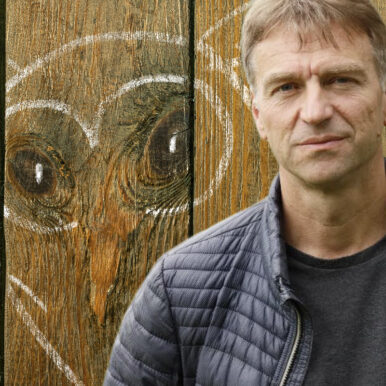
How do forests intertwine with the experiences of Estonian men and women, and how do they shape their worldview and way of thinking? Why are the peripheries so important in Estonian culture? How does a place to live differ from a place to be? We will discuss these and other topics during a meeting with Valdur Mikita, to which we invite you on 1 October at the National Old Theatre. The discussion will be moderated by Bartosz Sadulski.
1 October 2026, 18.00
Venue: Strefa BE, 1 Jagiellońska Street, National Old Theatre – Kraków
Consecutive interpreting: Reet Otsason
An event co-organised with the Embassy of the Republic of Estonia in Warsaw and the National Old Theatre in Kraków.
We invite you to a meeting with the Estonian writer, whose essays and sketches paint a portrait of a country woven from stories hidden amongst trees, wetlands, back gardens and remote places. In one of his essays, Valdur Mikita notes that ‘[…] if human understanding of the world were to become more ‘plant-like’ or ‘fungal’, there might be more sprouting and blossoming in it, and less frantic rushing about and constant striving to move forward. Through the rigidity of thought and the haughtiness of their nature, humans have lost the ability to learn from other beings. The world around them has fallen silent”. The author of the book “Leśtonia” views forests with exceptional sensitivity and shows how they can be experienced in the context of modernity. In his book, ancient beliefs, traces of Finno-Ugric culture, as well as stories woven from memories and coexistence with nature, correspond with the history of the country and its transformations.
The author of the book “Leśtonia”, published by ICC Publishing, moves effortlessly from childhood memories to linguistics, ethnology, neurology, geology and palaeontology. He combines erudition with humour and imagination, painting a portrait of Estonia as a country where the modern still coexists with the archaic and untamed. The Polish volume brings together essays and sketches drawn from several of the author’s books. The selection was made and translated from Estonian by Anna Michalczuk-Podlecki.
“Leśtonia” is the fourth volume in the Ister series, edited by Paulina Małochleb and Bartosz Sadulski.
The book is available for pre-order on the ICC Bookshop website
Valdur Mikita (b. 1970) – an Estonian writer and semiotician, a graduate in biology from the University of Tartu, where he also obtained a PhD in semiotics. In his work, he combines the essay, cultural theory, literary experimentation and nature writing. He gained prominence in Estonia with his bestselling collection “Lingvistiline mets” (2013), which explores the connections between language, landscape, memory and Estonian identity. He is the recipient of the Award of the Estonian Cultural Endowment and the Virumaa Literary Prize. In 2025, he was awarded the Order of the White Star, 4th class.
Bartosz Sadulski – writer and editor, author of three volumes of poetry, as well as the novels “Szesnaście na Bourbon” and “Rzeszot,” for which he received the Kościelski Prize, and was nominated for the “Nike” Literary Award and the Conrad Prize. Editor-in-chief of the quarterly HERITO. He has published essays in “Tygodnik Powszechny” and “Dwutygodnik”, among others. Recipient of the Młoda Polska scholarship in the literature category in 2019. He lives in Nowa Huta.