

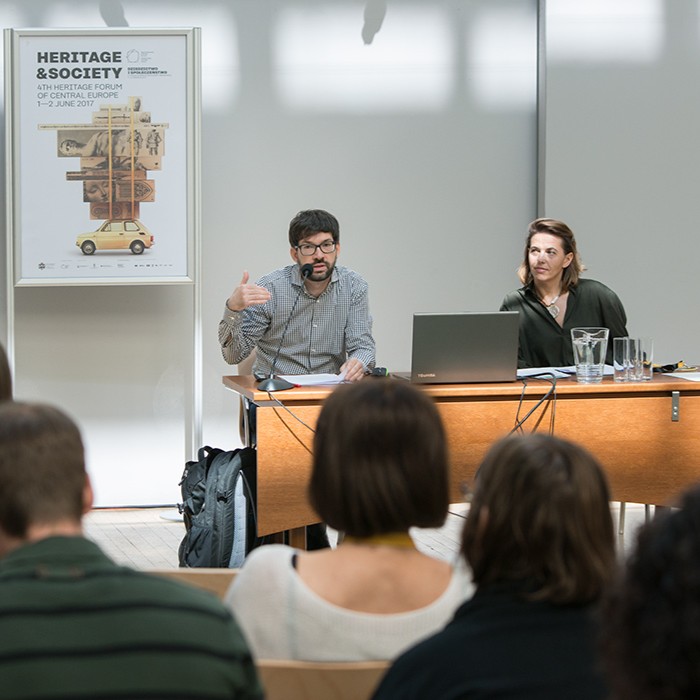
The aim of the 4th edition of the conference (held on 1-2 June 2017) was to discuss and analyse the relationships between heritage and society. The decision to prioritise the question of heritage’s impact on contemporary society—culturally, politically and economically—was linked to an assessment of the current state of research in heritage studies. For some time now, the ties between society and heritage have been recognised as one of the most important aspects of the debate on the legacy of humankind, both tangible and intangible.
Equally important for the conference organisers was the perspective proposed by Brian Graham, Gregory Ashworth and John Tunbridge, who argue that the category of heritage should be extended to encompass “almost all forms of intergenerational exchange or relationships established both between communities and individuals—whether desired or undesired”. According to the authors of this concept, people themselves are the “creators of heritage”.
In this context, several key questions were posed during the 4th Heritage Forum of Central Europe: What is the contemporary relationship between society and heritage, including its significant—yet often difficult—past? In what ways does heritage shape the communities in which we live? Who owns heritage, and why? What are its social functions? What do we choose to remember, and what do we often attempt to forget?
OPENING LECTURE: “Opportunities and Responsibilities of Non-Governmental Organisations as Guardians of Cultural Heritage” – Tamás Fejérdy
Over the course of the two-day Forum, papers were presented by 71 researchers from 20 countries—Austria, Belarus, Croatia, Montenegro, Czechia, Greece, the Netherlands, Ireland, Malta, Germany, Poland, Portugal, Romania, Slovakia, Slovenia, Sweden, Ukraine, Hungary, the United Kingdom and Italy. The presentations were organised within four main thematic blocks: unwanted heritage, heritage protection in the light of contemporary social challenges, constructions of memory, and heritage and communities.
The Heritage Forum of Central Europe was organised by the International Cultural Centre
A group of distinguished heritage scholars was invited to deliver the plenary lectures: Prof. Sharon Macdonald of Humboldt University of Berlin / the University of York; Prof. John Tunbridge, Professor Emeritus of Carleton University in Ottawa; and Prof. Rob van der Laarse of the University of Amsterdam.
In his lecture, John Tunbridge offered a historical and critical diagnosis of the state of heritage studies and called for a broader shift towards recognising the immaterial dimensions of heritage. Drawing on three international research projects she has led, Sharon Macdonald presented emerging trends and new models of reflection on heritage, as well as mechanisms for engaging heritage consumers and users. In his presentation, Rob van der Laarse announced the decline of the Holocaust paradigm in memory studies and the return of so-called “memory wars” in the context of rising nationalisms in Europe.
All three lectures were widely promoted and open to the public, each attracting nearly two hundred attendees.
Downloads

PDF (0.59 KB)

 Print
Print