
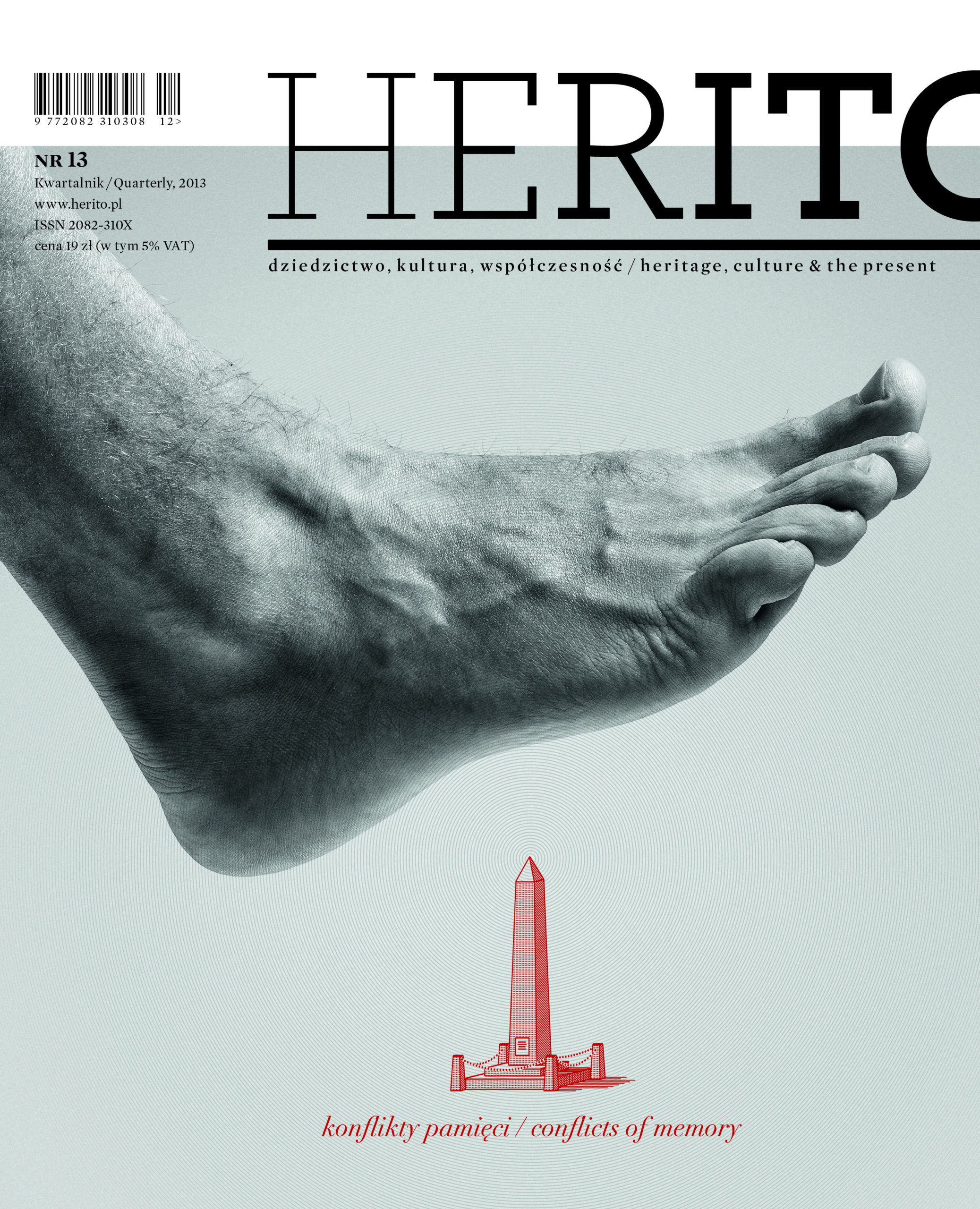
Each community devises specific modes of remembering, but also of forgetting uncomfortable facts. Ars memoriae and ars oblivionis constitute an inseparable pair, as Robert Traba points out. And, he adds, forgetting is sometimes necessary in order to find some kind of balance after tragedy and turmoil, but – he also warns – excessively fixed forgetfulness may turn into the nightmare of fratricidal struggle. An ideal goal would be “polyphony of various types of memory” and “a conscious balance between remembering and forgetting”.
But how could this ideal be put into practice? Stanisław Obirek attempts to offer a solution. Instead of a confrontational model, whose essence is defending one’s own vision of the past, he proposes a dialogic model – an approach driven by curiosity. This is because true dialogue excludes planned forgetfulness, Obirek says, and rather encourages a change in one’s own stance resulting from newly discovered facts. Following this idea, in this edition of “Herito” we try not only to become oriented in the nature of conflicts of memory, but also to look around the landscape of memory that surrounds us, Central Europeans. For, above all, one needs to start with oneself.
Content
Editorial
Worth a look
Stanisław Obirek – On Dialogue in the Context of Conflicts of Memory
Robert Traba – The Necessity to Forget, or How to Cope Ars Oblivionis
Sharon Macdonald – Europe as a Memoryland
Ewa Chojecka – Upper Silesian Conflicts Concerning Historical Memory. New Identities in Statu Nascendi
Maciej Czerwiński – Former Yugoslavia – a Topography of Collective Memory
Elżbieta Janicka – Memory and Identity in the Former Warsaw Ghetto Area
Agnieszka Zabłocka‑Kos – More Intellect, Less Emotion. In Search of a Balanced Narrative in Historical Museums in Poland
We Have Constructed Europe. Now We Need to Construct Europeans. Unpublished interview. Leopold Unger talks to Katarzyna Romańczyk
Europa Nostra: Fifty Years in the Service of Europe’s Heritage. An interview with Sneška Quaedvlieg‑Mihailović
Edyta Gawron – Confronting Memory in a Time of Change
Katarzyna Kotyńska – Double Palimpsest
Katarzyna Kotyńska – Myth Made Cheesy
A Story and History. Peter Krištúfek talks to Peter Michalík
Sylwia Trzaska – The Rite of Spring in Szczecin
Zoltán Gyalókay – Portraits. Traces of Memory
Wojciech Wilczyk – Why Create a Photographic “Archive of Reality”?
Michał Korta – Faces from the Past
Pol Capdevila – Josep Maria Cabané’s Memory and Blindness