
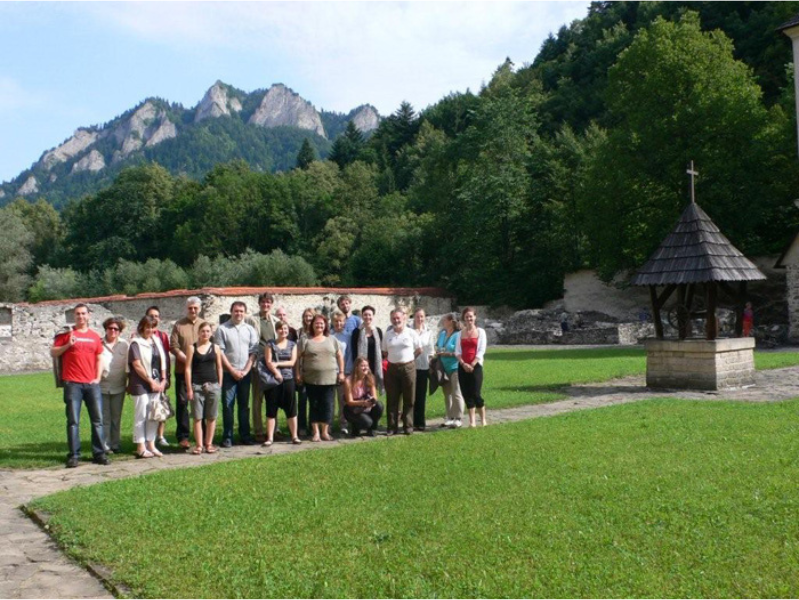
The academic panel for the session comprised representatives of institutions involved in the work of the Expert Panel, including Dr Katarína Kosová, Director-General of the Monuments Board of the Slovak Republic, and Ľubica Pinčiková from the Monuments Board of the Slovak Republic (Pamiatkový úrad Slovenskej republiky), Dr Tamás Fejérdy and Dr Gábor Soós from the Office for the Protection of Cultural Heritage in Budapest (Kulturális Örökségvédelmi Hivatal), as well as Prof. Jacek Purchla and Dr Michał Wiśniewski from the International Cultural Centre. The course programme began in Kraków with participation in the proceedings of the 1st Central European Heritage Forum.
The three-day conference, which presented contemporary examples and methods of cultural heritage conservation, served as an introduction to a series of lectures and seminars prepared exclusively for the course participants. These focused on selected sites and properties from the Polish and Slovak UNESCO Lists, as well as contemporary trends in the philosophy of cultural heritage conservation. Dr Tamás Fejérdy, who is involved in the work of the UNESCO World Heritage Committee, commented on current changes taking place in the management of the UNESCO List. Dr Gábor Soós presented new regulations concerning cultural landscapes and intangible heritage.
Whilst still in Poland, the course participants explored the historic sites of Kraków and visited the Church of St Michael the Archangel in Dębno Podhalańskie. In Slovakia, they visited the historic centre of Kežmarok and Levoča, along with Spiš Castle and the Romanesque church in Žehra. A separate part of the programme was devoted to the historic sites of Bardejov and the wooden churches on the UNESCO World Heritage List: the church in Hervartov and the Orthodox churches in Ladomirová and Bodružal. An additional highlight of the programme was the Red Monastery, a Baroque Carthusian hermitage situated right on the border with Poland and managed by the Council for the Protection of Monuments of the Slovak Republic, a co-organiser of the course. The former monastery, which now serves as a museum and conference centre, provided accommodation and conference facilities during the Slovak part of the course.
The course helped those involved in heritage conservation to examine issues common to all countries in the region. It served to broaden knowledge of the UNESCO List and helped to bring together conservation communities in Central Europe.