
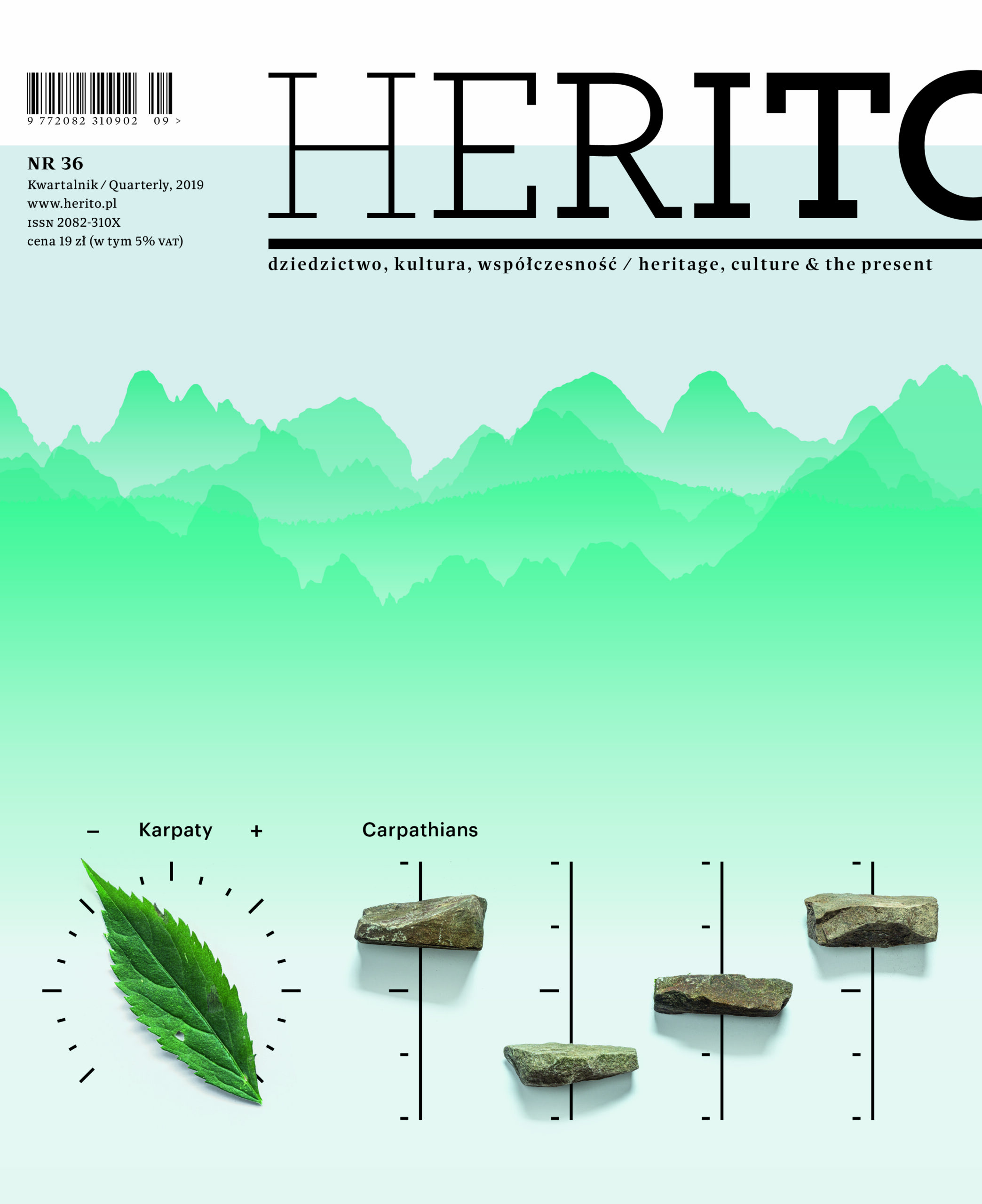
They span over nearly fifteen hundred kilometres across the territories of eight countries and cover the space five times the size of Switzerland. For centuries they have offered the ground for the development of cultures and small centres of the world of the Boykos, Lemkos, Hutsuls, Wallachians, Székelys, and the Transylvanian Saxons. Persistently still, they rarely minded the ideas conceived by flawed cartographers – they rather connected than divided, while today they offer a perfect reference point for the discussion about Central European heritage. The Carpathian Mountains, for they are discussed here, are the leading theme of the recent issue of “Herito”.
In the issue, Maciej Pinkwart deconstructs the myth of the “Polish Athens” – Zakopane – and indicates who and where invented the shower; Andrzej Dybczak travels across the wild growing orchards on the Poprad River and searches for the traces of the Lemko homesteads; Weronika Drohobycka-Grzesiak looks inside a Hutsul farmhouse from the early 20th century; Andriej Lubka brings back the mosaic history of Zakarpattia; Csaba G. Kiss explains why the Hungarians are still nostalgic about the Carpathian hills; Bogumił Luft takes us to the Székely Land, while Wojciech Stanisławski to the mountains of Transylvania; Patrice M. Dabrowski describes the changing attitude of the Polish authorities to the Bieszczady Mountains; Radoslav Passia investigates the orientalisation of Carpathians in Polish, Slovak, Ukrainian and Romanian literature.
Moreover, the issue includes an essay by Bartosz Sadulski on Ménie Muriel Dowie – a twenty-two-year-old English traveller from Liverpool who covered the route from Kolomyia to Chornohora in the late 19th century. An excerpt from her bestselling account translated by Aga Zano closes the 36th issue of “Herito”.
This issue of “Herito” features reviews of books by Olga Drenda, Wojciech Wilczyk, Aleksandra Wojtaszek, as well as announcements of interesting exhibitions in Berlin, Budapest, Bratislava, Krakow, Prague, Vienna, and Warsaw.
Content
Editorial
Worth a Look
Lost space. Magdalena Petryna talks to Anna Nacher and Marek Styczyński
Maciej Pinkwart – The myth of Zakopane. From sheep’s whey treatments to a perfect New Year’s Eve
Patrice M. Dabrowski – Transforming Poland’s “Wild West”
Radoslav Passia – On the border. The Literature of the Eastern Carpathians
Weronika Drohobycka‑Grzesiak – Watermelon soup
Andrij Lubka – Transcarpathia. The edge of all countries
Csaba G. Kiss – The cult of the Carpathians in Hungarian literature: a mosaic
Bogumił Luft – Backbone of Romania
Wojciech Stanisławski – The Saxon reef
Why did we come back? Nicholas Hodge talks to Tibor Kálnoky
Nick Thorpe – Bear corridors
Klaudia Kuraś – The Carpathians in a nutshell
Andrzej Dybczak – A White Line
Bartosz Sadulski – From Byron to Red Poll
Ménie Muriel Dowie – A Girl in the Carpathians
Worth a Thought