
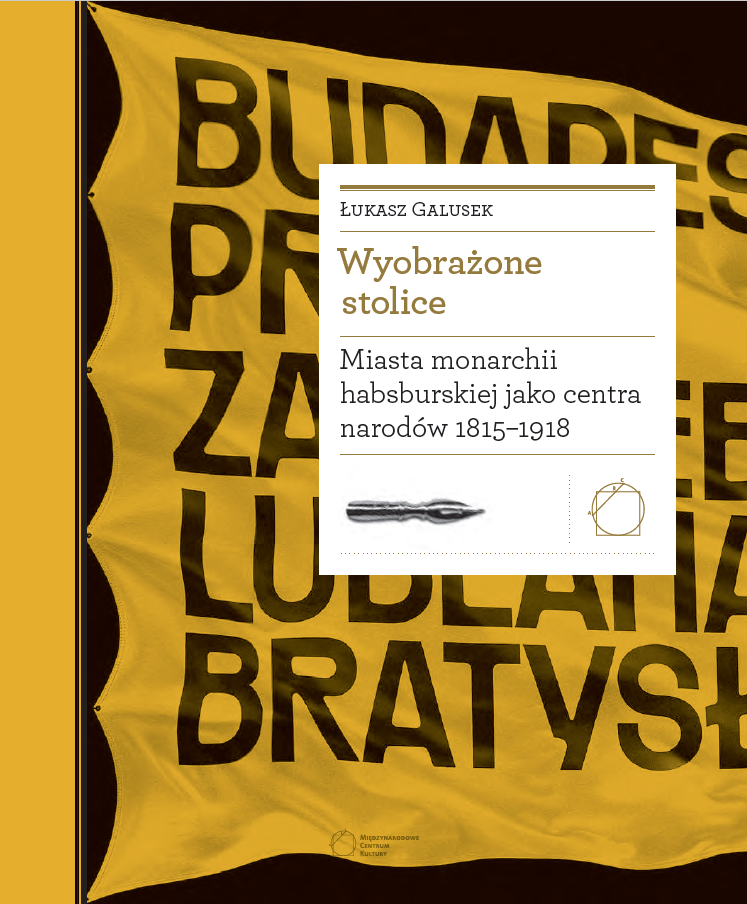
Can a capital city exist without a state? And can a city become the centre of a nation before that nation gains independence?
Łukasz Galusek’s book explores nineteenth-century Central Europe, where nations without their own states created their own “imagined capitals“.
Budapest, Bratislava, Ljubljana, Prague and Zagreb were not yet capital cities – at the beginning of the nineteenth century, they did not even play a significant metropolitan or political role – but even then they were becoming spaces in which a modern national identity was taking shape.
This is a story of ambitions, aspirations and symbols – of how architecture, urban planning, culture and historical memory forged a sense of community. Within a multi-ethnic empire, these cities became the “hearts” of nations even before they attained the status of official capital.
As early as the nineteenth century, they were perceived as the ‘own’ capitals of individual nations, and by the time independence was regained – in 1918 – they possessed an almost complete capital city programme, enabling them to assume this role.
The author demonstrates that the status of a capital city is not merely a matter of politics, but above all of imagination and culture. By analysing the relationship not so much between the city and the authorities as between the city and the nation, he reveals the process of shaping the ‘imagined capital’ as a form of communal existence – even in the absence of political sovereignty. It is precisely through the city that a nation communicates its distinctiveness and constructs its spatial imagination.
These imagined capitals also represent an attempt to answer the question of how stateless nations create their own centres and how – under political conditions that are unfavourable yet nevertheless offer certain opportunities – they realise, through urban forms, their desire for cultural and civilisational autonomy. This collection of five cities – ranging from Budapest, with a population of nearly one million, to Ljubljana, with a population of forty thousand – illustrates the full spectrum of Habsburg urbanity and the various paths to becoming a capital.
This is a book for anyone who wishes to understand how nations are formed – and what role cities play in this process.
The twenty-fourth volume in the Library of Central Europe series.
Table of Contents
Wprowadzenie
Stolica narodu
„Absolutyzm się zużył i powstał nowy porządek rzeczy”
Budapeszt
Praga
Zagrzeb
Lublana
Bratysława
„Nowoczesne Ateny” małych narodów
Podsumowanie
Kilka słów o literaturze przedmiotu
Przypisy
Bibliografia
Indeks nazwisk
Indeks miejsc i obiektów
Źródła ilustracji
O autorze