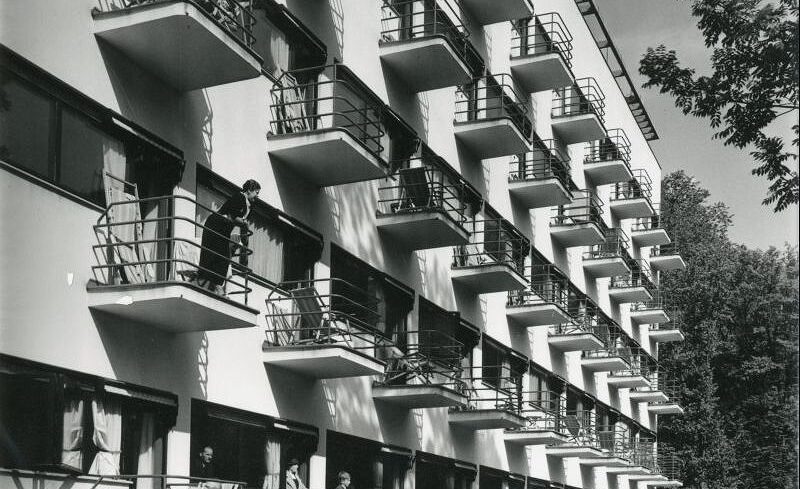
Modern sanatoriums, fashionable resorts or city swimming pools, paraphrasing the words of Paul Overy, assumed the symbolic role of a pristine, white “clean machine”, a cruise ship taking patients on a magical journey from an old, unhygienic and unhealthy world of the past to a new life full of physical and mental strength , fresh air, sunshine, hygiene and cleanliness. Associations with a cruise ship are not accidental, because references to ship style are often found in the architecture of that time.
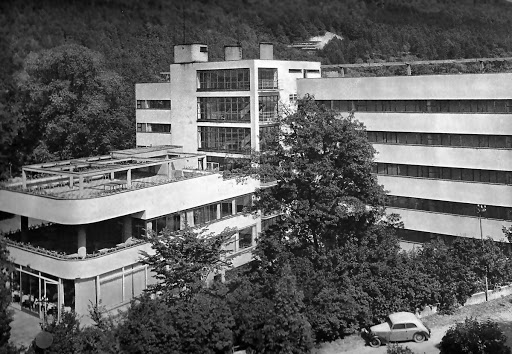
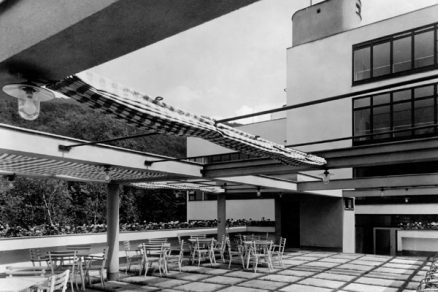
We will find them in the Machnáč sanatorium in Trenčianske Teplice – one of the best examples of this type of architecture in Central Europe. Located in the Slovak part of the newly formed First Czechoslovak Republic, the complex was designed in the 1930s by Jaromir Krejcan – an outstanding representative of the Prague avant-garde. At that time it was one of the largest and most expensive investments of this type in the country. The building uses a set of solutions characteristic of the interwar modernist architecture, such as a reinforced concrete structure enabling the use of open spatial arrangements, ribbon windows, glazed staircases or an extensive roof terrace and on the ground floor level, which was easily accessible through a wide ramp. The layout of the sanatorium was divided into two parts and consisted of a wing housing the hall, kitchen, dining room and recreation rooms as well as the adjacent six-storey part with guest rooms.
Publications
Publications
Modern, wide windows used in them provided proper lighting and ventilation of the rooms, and private balconies, opening at the view of the nearby park, gave the patients unlimited access to the sun and fresh air. Their characteristic arrangement not only became a peculiar emblem of the whole assumption, but also evoked associations with the boarding school designed by Walter Gropius of the Bauhaus school in Dessau. The architecture of the object harmonized perfectly with the guidelines of the therapy used there – one of its elements was sun treatment. Anyway, the tanned, healthy and athletic body was part of the ideal of beauty that was widely promoted at that time. In the Trencin sanatorium, patients could enjoy sunbathing both in the privacy of private balconies and on the shared terrace. These practices are reminded by photos of Rudolf Sandalo, a Brno photographer, whose archives contain documentation of many inter-war implementations, including as iconic as the famous Villa Tugendhat. The photos of the Trencin sanatorium are not only a valuable iconographic source, but also part of the then popular phenomenon used to popularize modern architecture using a photographic medium.
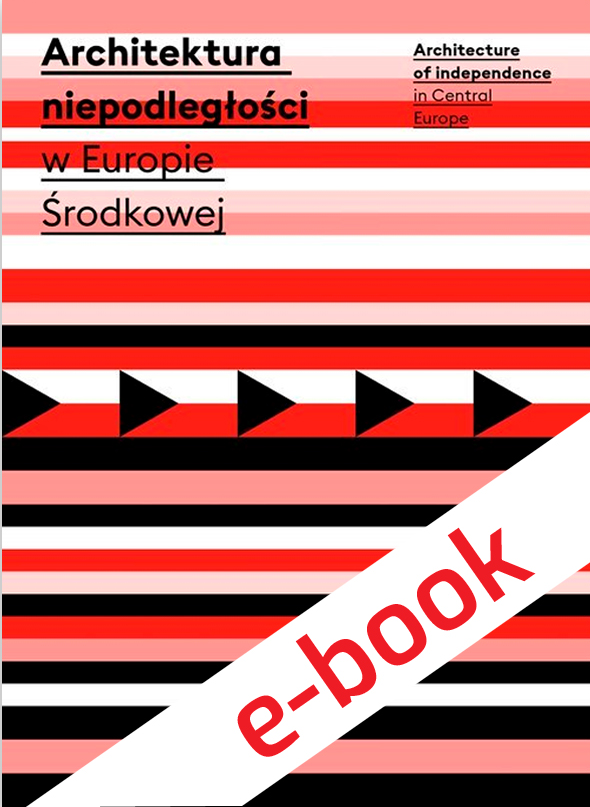
More about architecture and urban planning after the First World War can be read in the publication Architecture of Independence in Central Europe available in the ICC online bookstore.
Publications