
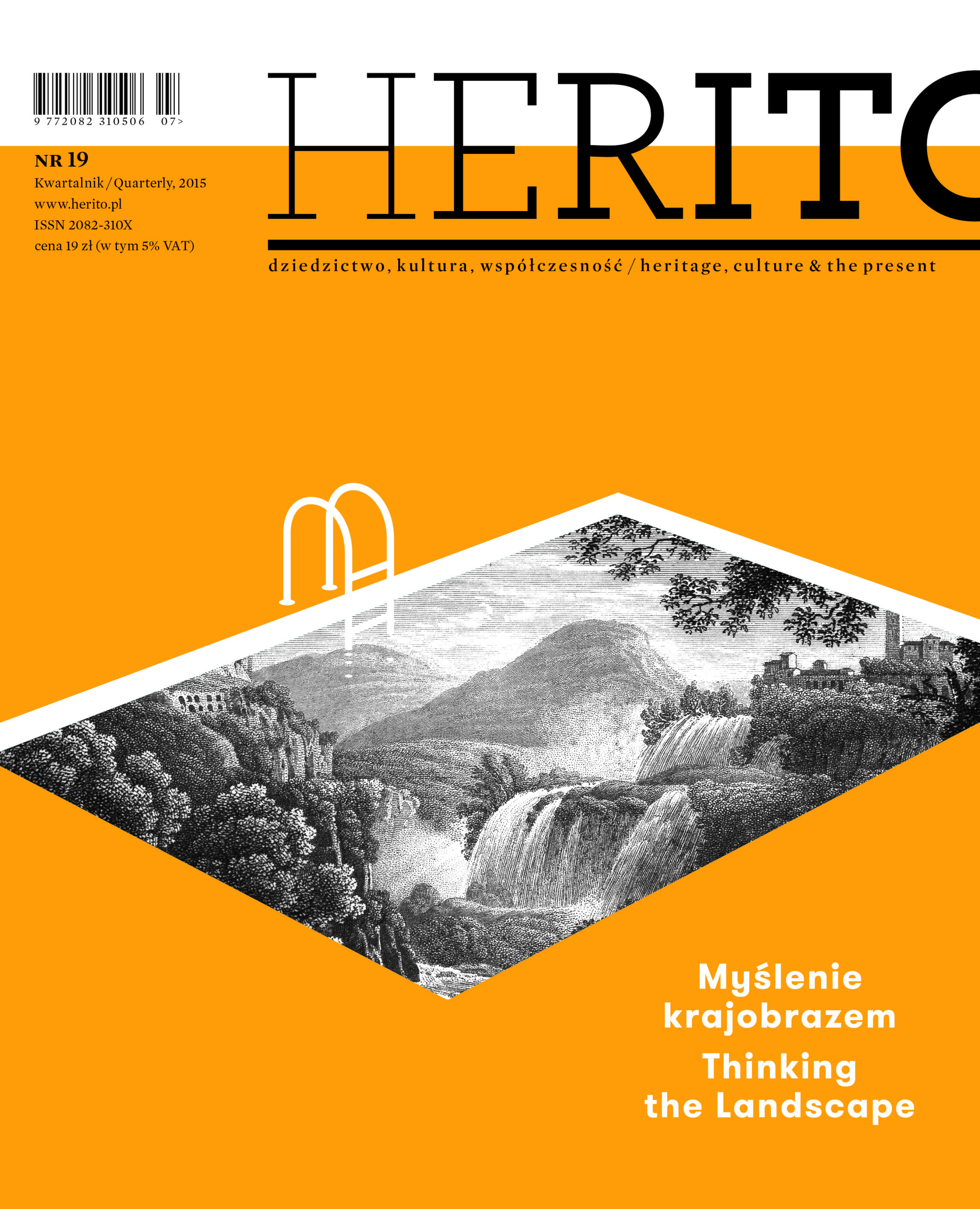
“Landscape is more than painterly or visual effects,” Stanisław Vincenz wrote in 1943. “It is also the soil on which we walk and which we work, its undulation or flatness, its waters – seas, rivers or marshes – and even the air that we breathe.”
Without man, without his presence, the world will not become a landscape, just as space itself is not place, but only becomes it through thought and spirit – i.e. understanding. It is understanding that transforms a space into a place, understanding that permits living, as Heidegger wrote. Landscape is a record of that transformation, of the process of becoming at home in the world; a record that we have learned to “read”.
Today the list of fields that have turned their attention to landscape is a very long one: from geography, art history and photography, and aesthetics, through ecology, landscape architecture and cultural studies, to research into memory, cultural heritage, and even law and economics – which is proof of the success of the recently passed “Landscape Act”.
The landscape is the environment of the life and activity of humankind. It is also image, memory, and a way of seeing the world. It is material for art and the substance of memory. In this issue of “Herito”we want to show the variety of its manifestations and the diversity of considerations in researching it. For it is through thinking that we create landscape.
In the issue: Maciej Czerwiński, Juraj Čorba, Uwe Rada, Elżbieta Rybicka, Janusz Sepioł, Tadeusz Sławek, Magdalena Zych look at the changing relations between humans and landscape; Monika Rydiger i Łukasz Galusek discuss landscape as an artistic fabric; Magdalena Petryna profiles the BWA gallery in Tarnów; Łukasz Galusek, Peter Míchalik, Kinga Migalska, Katarzyna Kotyńska, Wojciech Wilczyk, Michał Wiśniewski recommend important books and exhibitions; Mileta Prodanović deciphers the palimpsest that is Belgrade’s cityscape and the changes to it in the last decade of the 20th century; Michał Książek on reading a forest.
Content
Editorial
Worth a Look
Elżbieta Rybicka – Landscape. A Brief Introduction
Tadeusz Sławek – A Temporary Cessation of Habit. On Experiencing the Landscape
Magdalena Zych – On the Land
Uwe Rada – Return to the River
Juraj Čorba – Thinking Mountain. Thinking River
Maciej Czerwiński – The Literary Veduta. Variations
Janusz Sepioł – Landscape Architecture. The Idea and the Method
The Lay of the Land. Łukasz Galusek talks to Dr Monika Rydiger
Magdalena Petryna – Periphery Self‑assured
Wojciech Wilczyk – Everything the Old Way
Michał Wiśniewski – Polish Identity vs. Modernisation
Worth a Thought – Łukasz Galusek, Katarzyna Kotyńska, Kinga Migalska, Peter Míchalik
Mileta Prodanović – Patopolis
Michał Książek – Listening to the View