
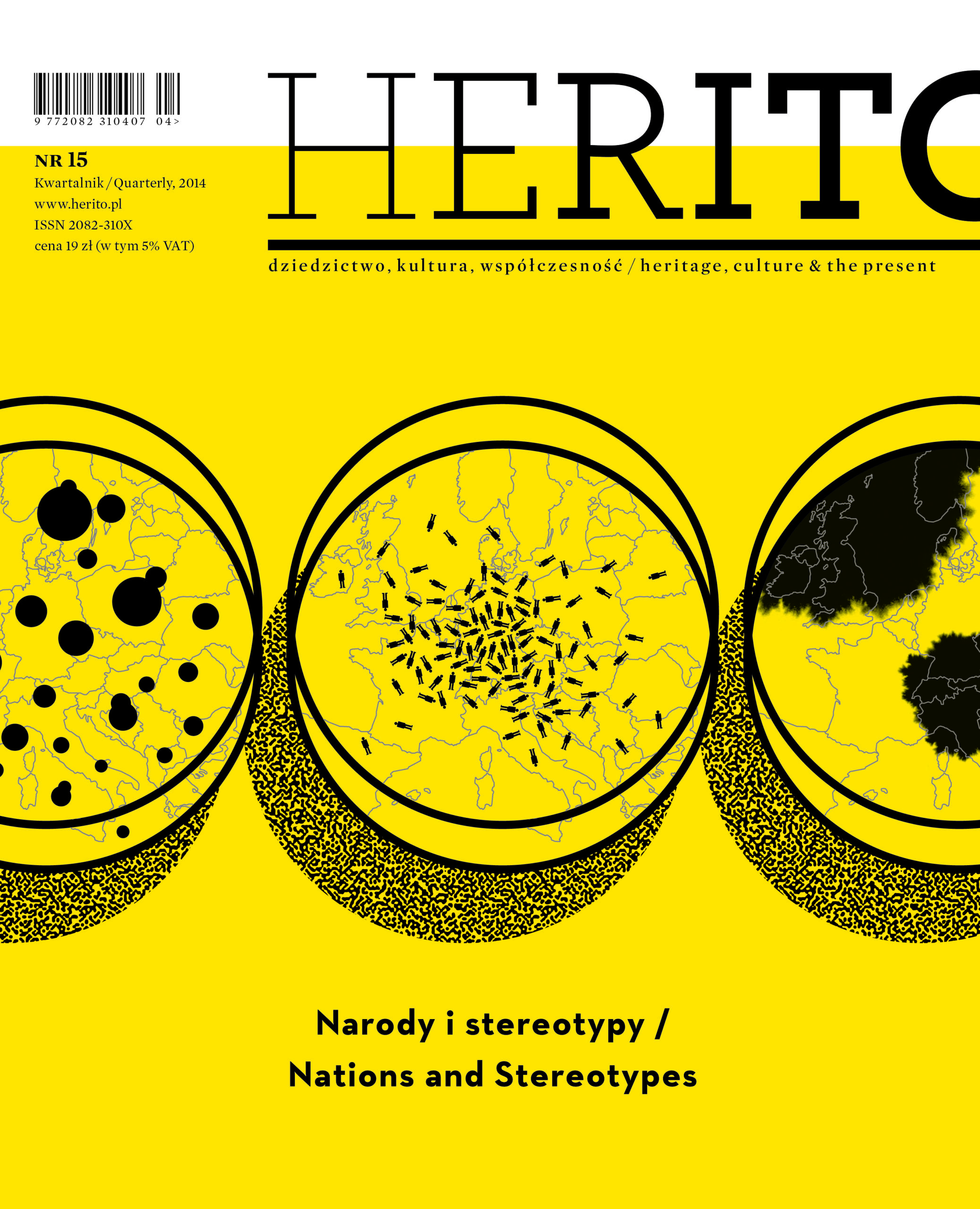
Stereotypical thinking is deeply rooted in culture, history and collective memory. It does not solely mirror real, old or recent conflicts, although it cannot be entirely separated from them. And yet the political situation can be the most effective method of changing the stereotype. We do not have to look far for examples. One can even say that we have some happening now in our own backyard. In this issue on nations and stereotypes the subject is discussed by Shlomo Avineri, Maciej Czerwiński, Tadeusz Lubelski, Piotr Majewski, Mykola Riabchuk, Ziemowit Szczerek and Łukasz Trzciński.
Also in the issue: Mirosław Bałka and Kasia Redzisz in a conversation on how art corresponds with its place, Stefan Kraus on an extraordinary museum in Cologne designed by Peter Zumthor, Wojciech Szymański on visible and “invisible” Joanna Rajkowska, Edyta Gajewska on the Gierymski brothers, Wojciech Wilczyk on the unknown landscapes by the Oder, Beata K. Nykiel on a “pure white breed” of horses from Lipnica and Emil Brix on a different meaning of 1989.
Content
Editorial
Worth a look
Shlomo Avineri – Mare Nostrum – Metaphor and Reality
Maciej Czerwiński – The Stereotype – in the Trap of Cognition
Mykola Riabchuk – The Fourteenth Worst Place
Ziemowit Szczerek – Unbearably Eastern Poland
Tadeusz Lubelski – Polish Men and Women in our Recent Cinematography
Piotr Majewski – Stone Worshippers. The Skopje 2014 Project
Łukasz Trzciński, Magdalena Petryna – New Europe
Art Negotiates with Space. Mirosław Bałka and Kasia Redzisz talk to Monika Rydiger and Natalia Żak
Cologne, a Museum, Zumthor. Stefan Kraus, director of Kolumba Museum, talks to Żanna Komar
Wojciech Szymański – Joanna Rajkowska: Visible and Un‑seeable
Edyta Gajewska – Gierymuses Return
Wojciech Wilczyk – Unknown Landscapes on the Oder
Beata K. Nykiel – Horse and Genetics, or the Centre of Europe in a Courbette
Maciej Czerwiński, Łukasz Galusek, Peter Michalík – Worth a Thought
Emil Brix – The Other Meaning of 1989