
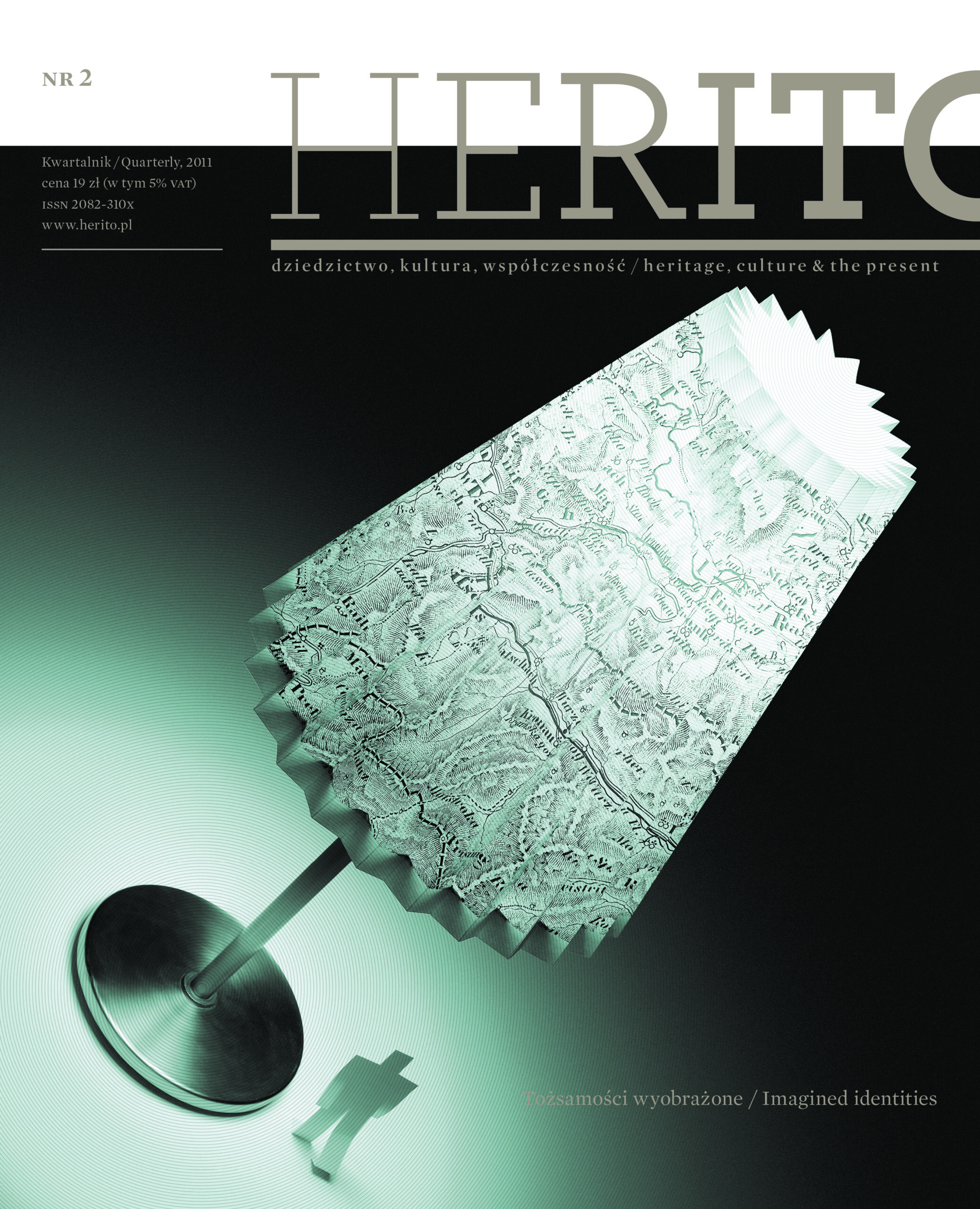
In today’s fluid times a human being is looking for a place and a place is looking for a human being; people want to feel at home in a space but spaces influence entire communities. This creates the need to imagine certain possible multilayered identities – for a place, for people, for a collective.
In the second issue, entitled Imagined identities, we look at attempts at breaking free from the straitjacket of traditionally defined belongings and ask the questions: if Italy still exists? Of how many countries Romania is composed? How is it to feel a Banatian, a Yugo-sympathiser, a Central-European? What is open regionalism today? Moreover in other sections of Herito we present Romanian Sibiu as European Capitol of Culture, describe Contemporary Art Tower in Vienna and temporary location of Contemporary Museum Wrocław – former bunkers now hosting modern art, and we share impressions from exhibitions and books from Warsaw, Germany and Russia.
Content
Editorial
Simona Škrabec – Imagined geography
Claudio Magris – Identity is a matrioshka: the sum of encounters and stories
Joanna Ugniewska – The translator’s gloss
Maria Dąbrowska‑Partyka – Yugoslav and post‑Yugoslav maps
Radu Pavel Gheo – Bila jednom jedna zemlja…
Marta Bucholc – A transmigrant’s identity
Ewa Chojecka – Three models of cultural memory: Kraków, Katowice, Wrocław
Żanna Komar – In search of the Jewish style. Archaeology of the Lviv modernism
Beata K. Nykiel – Viribus unitis. About Kaiserlicher und Königlicher Marinefriedhof in Pula and other things
Centrality need not be a curse. Prof. Robert Traba interviewed by Magdalena Petryna
Joanna Sanetra‑Szeliga – Sibiu – city of cultures
Mihaela Carpea – Sibiu – the European “self”
Katarzyna Jagodzińska – Bunkers with art
Żanna Komar – Constructing history
Beata K. Nykiel – Cultural heritage as seen by contemporary Russians
Helena Postawka – If you are reading this text, it means you are looking at it
Łukasz Galusek – A Triestine triptych (2)