
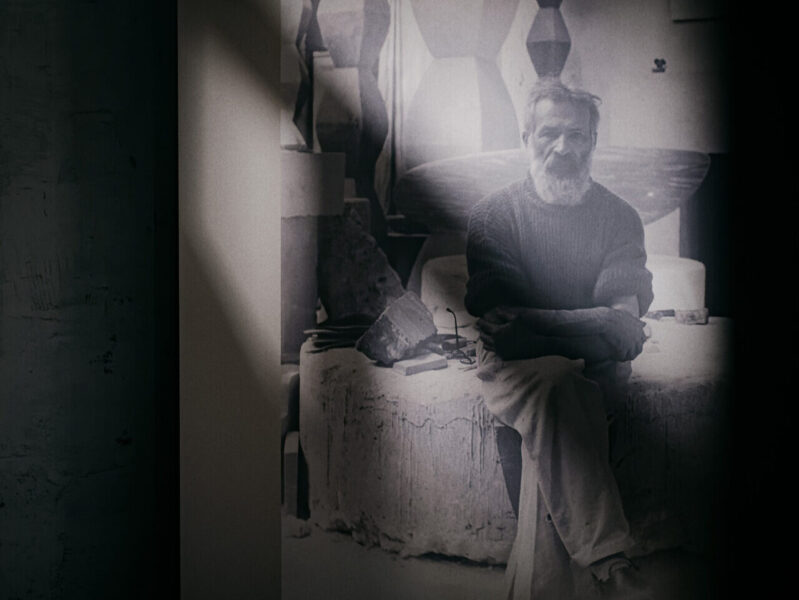
He was born in 1876 in the Romanian village of Hobița. He left Romania and eventually made his way to Paris. He photographed himself with a canvas bag on his back, creating the myth of a pilgrim who walked from the Carpathians to France. In reality, he traveled by train, stopping several times along the way and taking on odd jobs to be able to continue his journey. “He was half simple peasant, half real god” – claimed Peggy Guggenheim. And that is how he created his image, wanting to be remembered on his own terms.
He revolutionized contemporary sculpture, showing that light and shadow can give form new, deeper meanings. He perfectly presented this in his photographs, which became separate works of art and which we showed at an exhibition at the ICC Gallery from September to December 2025. Together with curators, contemporary artists and creators, special guests and the audience, we pondered the secret of Brâncuși’s work.
We invite you to re-enter the world of Constantin Brâncuși’s art and watch a film summary of the exhibition “Brâncuși. Sculpting with Light” at the MCK:
More about the exhibition “Brâncuși. Sculpting with Light”
The exhibition was co-organized by the International Cultural Centre in Krakow and the Romanian Cultural Institute in Warsaw.
The exhibition was part of the 2024-2025 Romania–Poland Cultural Season
The Romania–Poland Cultural Season 2024-2025 was organised by the Romanian Ministry of Culture and the Romanian Cultural Institute, together with the Polish Ministry of Culture and National Heritage and the Adam Mickiewicz Institute, with the support of the Polish Institute in Bucharest. During the season, several dozen events took place, including exhibitions, music, theatre, film and literary events.