
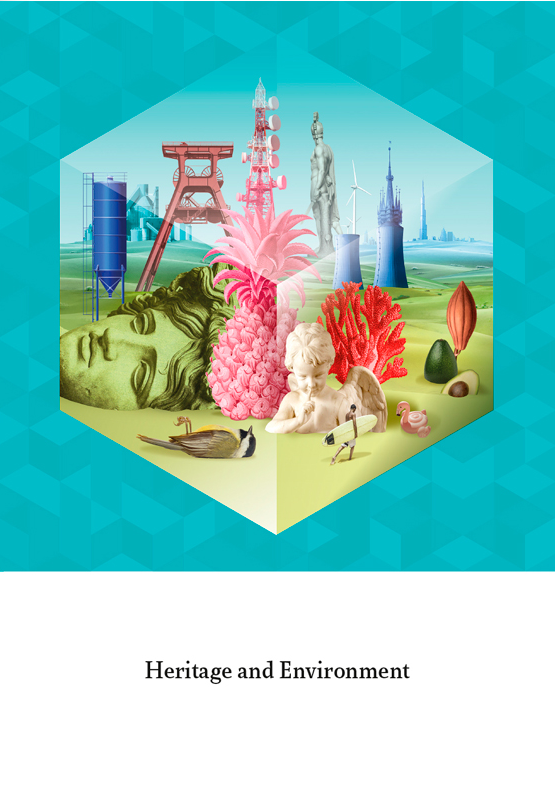
Książka jest pokłosiem 5. Forum Dziedzictwa Europy Środkowej, jakie odbyło się we wrześniu 2019 r. Było ono poświęcone związkom między dziedzictwem kulturowym a środowiskiem, a także ich wzajemnemu zaangażowaniu.
W publikacji znajdziemy dwadzieścia siedem tekstów pisanych przez europejskie specjalistki i specjalistów z zakresu dziedzictwa, m.in. Marie-Theres Albert, Artura Chojnackiego, Evę Chovancovą, Zoe Russel, Stsiapana Stureikę czy Tobiasa Strahla. Mówią one o tym, że kontekst środowiskowy ma ogromne znaczenie dla pełnego zrozumienia wartości i samego znaczenia dziedzictwa kulturowego, które pozostaje jednym z centralnych elementów tożsamości każdego z nas.
W ostatnich latach, a zwłaszcza w ostatnim czasie, stajemy się coraz bardziej świadomi, że pandemia lat 2020–2021, z jej ogromnym negatywnym wpływem na sektor dziedzictwa kulturowego, niewątpliwie pobudzi wiele instytucji dziedzictwa kulturowego do zajęcia się tematami związanymi z tzw. „zieloną rewolucją”. Uczestnicy 5. Forum Dziedzictwa twierdzą, że osoby i instytucje działające w obszarze dziedzictwa kulturowego są także odpowiedzialne za edukację i podnoszenie świadomości społecznej w zakresie troski o środowisko.
Publikacja w języku angielskim.
Spis treści
Jacek Purchla, Agata Wąsowska-Pawlik, Preface
Part 1: Environmental History and Protection
Adrienne Wallman, Lieux de Memoire: Genealogy, Memory, and Environment
Carola Hein, Tino Mager, Roberto Rocco, Henk von Schaik, Diederik Six, Water Histories and Heritage: Spaces, Institutions, and Cultures
Zoe Russell, Common-sense Discourses of Nature: A Gramscian Analysis of Conservation Designations in the Scottish Highlands
Maciej Ambrosiewicz, The Augustów Canal: The Creation of Man and Nature
Agnieszka Laudy, Historical Residences and Modern Challenges: Moving Towards Sustainability
Salvijus Kulevičius, Superseded Reality: The Reconstruction of Manor Parks in Soviet Lithuania
Artur Chojnacki, Towards Eco-heritage: Shaping the Relations between Nature and Cultural Heritage in Contemporary Kraków
Melinda Harlov-Csortán, From Environmentalised Heritage to Heritagised Environment: The Case of the Reedland at Fertő/Neusiedlersee
Part 2: Landscape
Eva Chovancová, Transformations of the Moravian Vineyard Landscape as a Political Consequence
Cristina F. Colombo, Museographical Perspectives on Modern Fortified Landscapes: World War I Defensive Lines in Italy
Tomás Pavlíček, Notes on the Reflexion of an Industrially Exploited Landscape in the North: Bohemia in the 20th Century Visual Arts – the Power of Image
John Ebejer, Despina Dimelli, Conservation Issues of Two Fortified Historic Towns and World Heritage Sites: Rhodes and Valletta
Kristína Jamrichová, Towards an Aesthetics of Interface: A Preliminary Study
Łukasz Bugalski, The Touristification of Italian Historic City Centres: The Lesson for Central Europe about the Airbnb Eruption
Part 3: Heritage and Political Environment
Tobias Strahl, Protection of Culture in Conflict: Heritage in a Militarised Environment
Karin Hallas-Murula, New Architecture and Heritage: Estonian State Architecture Policy in the European Context
Jerzy Gorzelik, Cultural Nationalisms and Heritage Discourses in a Contested Borderland: The Case of the Upper Silesian Wooden Church
Stsiapan Stureika, Synagogues in Post-Soviet Belarus and the Region: Overcoming Abandonment through Appropriation
Dalia Traškinaitė, Issues of Aesthetics in the New Architecture of UNESCO World Heritage Sites in Lithuania
Barbara Vodopivec, Multi-layered Significance of Heritage: Mapping Castles, Their Functions, and Environment in Post-World War II Slovenia
Part 4: Education
Michał Kępski, Landscape and Freeman Tildens Philosophy of Heritage Interpretation
Marju Kõivupuu, Inventory of Intangible Cultural Heritage: the Example of Estonia
Anna Gruszka, The Living River: A Practical Interpretation of Heritage Trends
Marie-Theres Albert, Transboundary European World Heritage: The Chance and Challenge of Building a European Identity through Education
Ágnes Balog, Two Roads One Mission: Cultural and Natural Heritage and Education of Children
Magdalena Szalbot, Heritage and the Environment from the Anthropological Perspective of Cultural Ecology
About the Authors